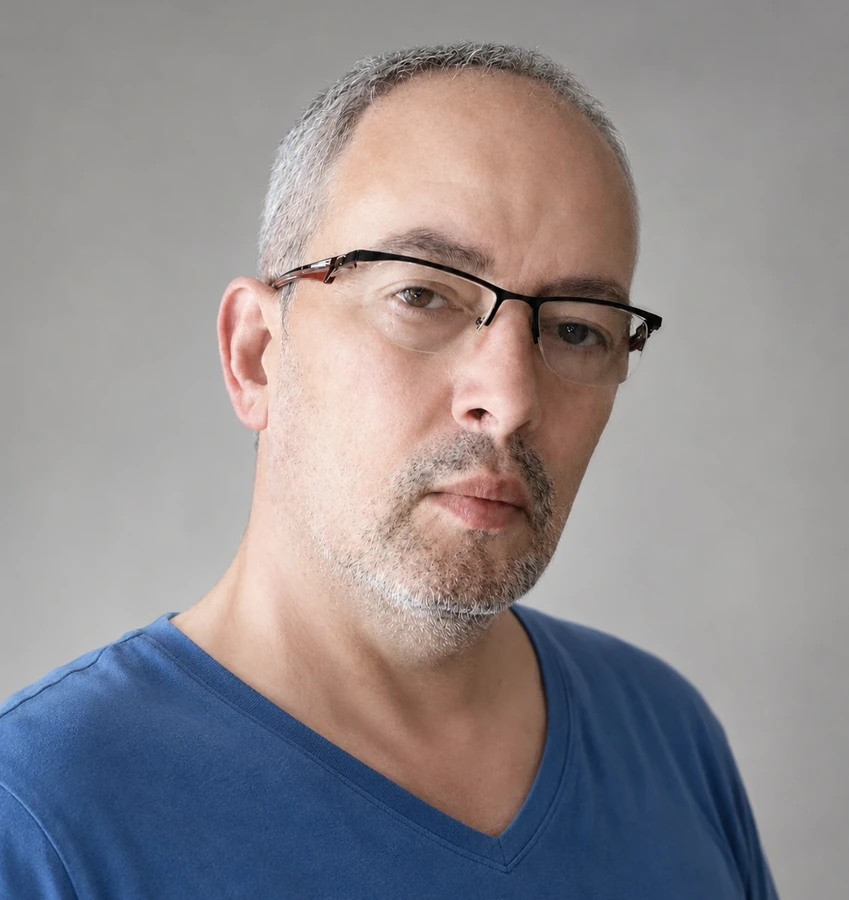
Dim Lazar is the public artistic name of Dimitar Lazarov — an artist and art photographer with more than 35 years of visual practice. Born in Peshtera, Bulgaria, he has lived in Plovdiv since his early teenage years. The city’s historical memory and visible layers of different periods have formed a natural environment for his development. In 1987, he graduated in Painting from the Tsanko Lavrenov National High School of Arts.
His practice spans painting, painted silk, fashion and visual performance, icon painting, art photography and visual systems. These fields have not developed as separate professional biographies, but as different expressions of a single authorial gaze. In the early 1990s, his exhibitions and performance projects were presented at the Regional Ethnographic Museum – Plovdiv and the International Fair in Plovdiv. Solo exhibitions in Sofia, Peshtera and Plovdiv’s Old Town followed. He has painted icons since 1996 and has developed his practice in art photography since 2007. His artistic work has never been interrupted — it has moved through different environments and forms, with each new direction building upon what came before.
The museum environment played a formative role in his early development. For several years, the Regional Ethnographic Museum – Plovdiv was not only a venue for his exhibitions and visual projects, but part of his everyday professional world. An important figure during this period was the ethnographer Zlatka Mitrovska — director of the museum and later director of the Guild of Masters of Folk Arts and Crafts — who supported and presented his exhibitions in Plovdiv and Sofia. Through her he met Ekaterina Langamer — a close friend of the artist, a senior professional in cultural heritage preservation within the Ministry of Culture, and an important source of support for presenting his work in Sofia. In 1994–1995, this support led to two solo exhibitions in Sofia, organised with the support of the National Centre for Museums, Galleries and Fine Arts at the Ministry of Culture. His current development of visual systems for museum and cultural contexts continues this early, deeply rooted connection. His paintings and icons are held in private collections in Bulgaria and abroad.
His photographic works have been selected for exhibitions, international catalogues and specialist publications, including the 31st FIAP Black and White Biennial in Palma de Mallorca, Spain. He received recognition from Dynaphos for his overall contribution and activity as an author in the Zoom Box photographic community, as well as a silver medal for art photography from Photoacademica. His photographs and authorial texts have appeared in the British magazine Practical Photography, the international boutique art publication SHARE by the Swedish publisher The New Heroes & Pioneers, and the anniversary volume X / 1x Yearbook 2017. He has also published the authorial photography tutorial Spaghetti on the international platform 1x.
In recent years, this accumulated experience has expanded into visual systems and an authorial methodology for interaction between the human and artificial intelligence. New technologies do not define his visual language or replace authorship. They enter an already established practice in which direction, aesthetics, selection, editing and final judgement remain part of the artist’s personal filter.
Until the beginning of his photographic practice, Dimitar Lazarov worked under the artistic name DIGEL, which remains his signature on artworks to this day. In photography he became known as Dim, and the later name Dim Lazar now brings together his complete public artistic presence. These are not separate identities, but successive layers of one core and one visual line.
Today, under the name Dim Lazar, he brings these directions together within a shared authorial space — between classical image-making, photographic observation, spiritual tradition and contemporary visual systems. Regardless of the medium, the central question remains the same: how can an image continue to develop without losing its inner measure, recognisability and authorship?
This website is part of the same practice: not a neutral portfolio, but an authorial visual environment, built step by step as evidence of the method.