This is not a universal recipe, but a personal authorial method for building and developing visual systems — a repeatable working logic through which accumulated visual experience can act in new environments and generate different solutions.
I work with the image not as an isolated picture, but as a system of relationships — between structure, light, material, rhythm, space and meaning. Whether the medium is painting, icon painting, photography or a digital system, I do not look for effect, but for the internal logic that makes an image alive and necessary.
One practice, different forms
Painting, icon painting, art photography and visual systems are not separate chapters of a biography. They are different fields within the same way of seeing.
I do not begin from zero with every change. I carry forward what has already been accumulated — knowledge, visual memory, intuition, aesthetics and authorial judgement — and connect it with the possibilities of the new environment. Previous experience is not left behind. It becomes a core from which new forms, solutions and applications can develop.
When one space closes, the image finds another path. In trying not to lose my connection with art, I found photography — not as a substitute for painting, but as another way to keep that connection alive. New technologies do not cancel what came before. They expand the field in which accumulated visual experience can act.
I do not leave the old world behind. I build a bridge to the next.
Concept as a foundation
A clear concept makes an idea resilient to change. It does not restrict form, but allows it to pass through metamorphoses without losing its inner direction. When the conceptual core remains stable, different solutions do not dissolve into random variations, but continue as parts of one evolving system.
Method in action
Interaction as method
Move through the field with a cursor or a finger. The core interacts with its environment, transforms it and leaves a trace — a visual model in which accumulated experience meets a new context and produces a different solution through each interaction.
The website as an authorial environment
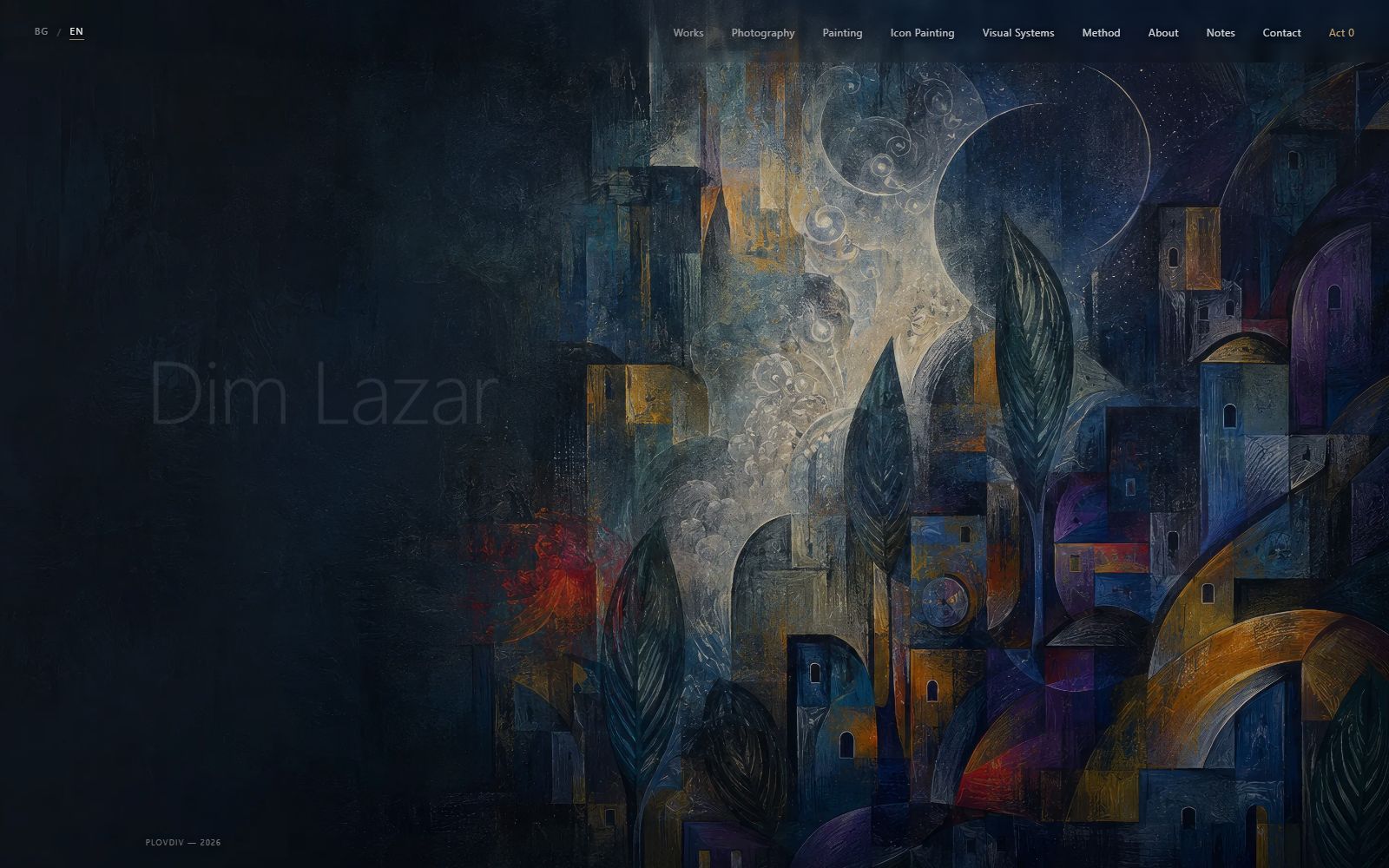
This website is not a neutral container for finished works, but an authorial environment built through the same method it presents. The homepage background was developed from an original painting by the author and compositionally adapted specifically for the digital environment, because a direct crop could not achieve the necessary spatial effect.
This is only one visible example of the process. The website was conceived and built step by step through conceptual and methodical continuity. Its structure, movement, light, language and navigation were developed as interconnected parts of one system in which content and form act together.
Constraint as an authorial decision
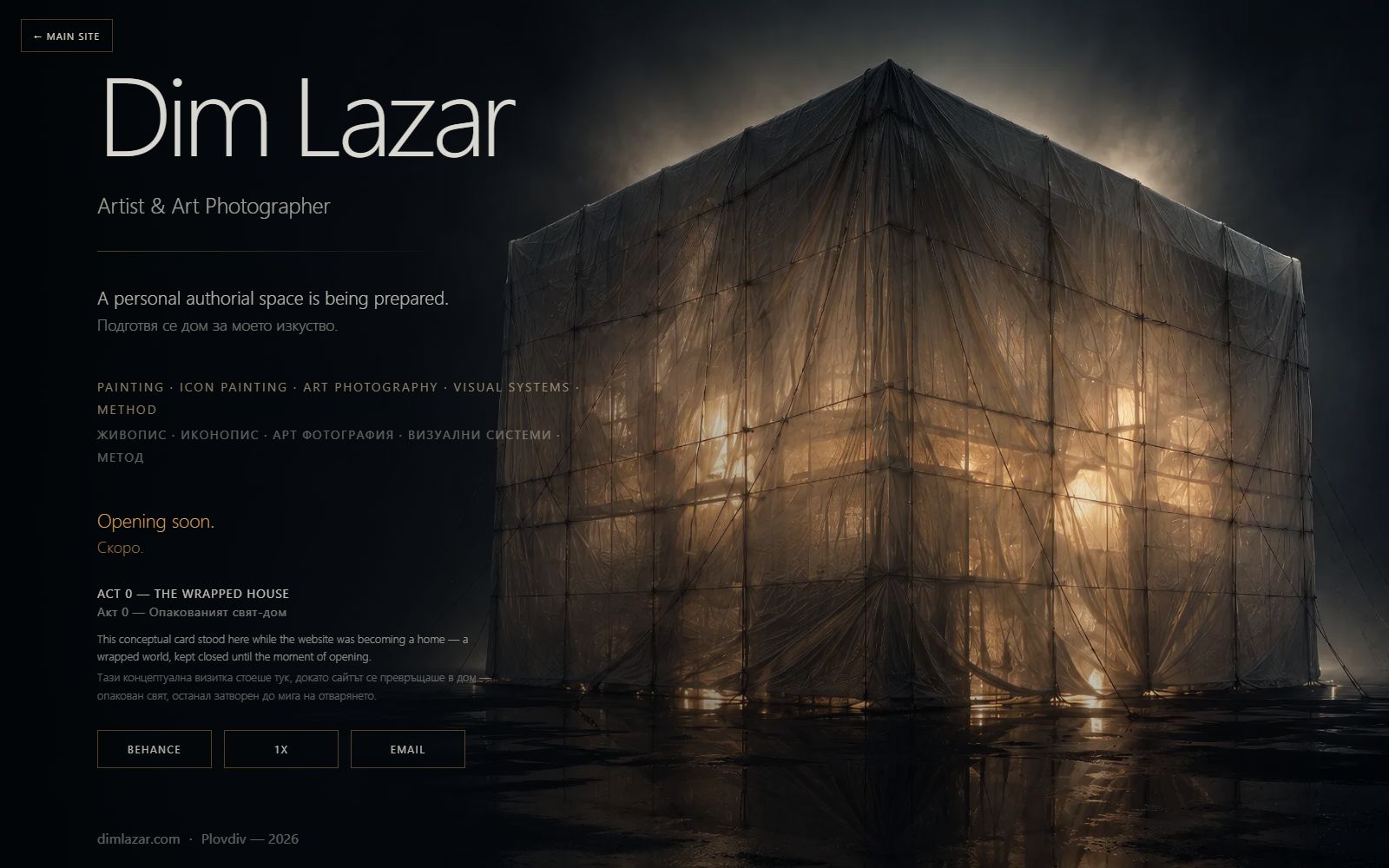
Act 0 was not a generic “coming soon” page. The practical need to keep the website closed became an independent conceptual work — a wrapped world, held in the moment before opening.
Interactive work © 2026 Dim Lazar. Unauthorised reproduction, adaptation or reuse is prohibited.
Dim Lazar — authorial website environment, 2026.
Act 0 — The Wrapped House, 2026.
Artificial intelligence as a space for interaction
Artificial intelligence is not the beginning of this method, nor is it a substitute for authorship. It enters a practice shaped over more than 35 years through work with composition, light, colour, matter, presence and restraint.
The basic capabilities of artificial intelligence in their raw form are not sufficient for my work. I work with an ecosystem of several different AI systems whose capabilities and limitations must be understood and managed according to the task. One of them maintains the deep context and continuity of the process, while the others contribute different abilities, perspectives and technical solutions.
As with any instrument, the result depends on knowing what it can do, where it fails and what it is suited for. The difference is that with artificial intelligence, the process itself can be discussed. This does not make it magical — it makes the interaction more complex and requires more precise direction.
I do not look for a ready-made answer, nor do I automatically follow what is produced. I set a direction, calibrate the context, recognise possibilities, filter and develop. I return to the image repeatedly — comparing versions, refining form, light and rhythm, and making manual interventions where necessary. Deep context allows the accumulated authorial gaze to act consistently and enables the collaboration to produce solutions that preserve a recognisable style and internal logic.
When two different systems are sufficiently well calibrated to one another, a third solution can emerge between them — not as an automatic product of the tool, but as the result of sustained interaction, selection and authorial judgement.
The method is repeatable, but the result is not. The underlying logic remains, while each new interaction produces different relationships, rhythms, densities and colours. Repetition does not create copies — it develops the system, expands its possibilities and enriches the core from which the next solution begins.
The authorial filter
The ease of generating images does not reduce the need for an author. It increases it.
Not every beautiful image is strong. Beauty may attract attention. Strength remains, carries meaning and opens space.
In this process, I am both radar and sieve. The radar detects direction and possibility. The sieve separates what is alive from visual noise. Authorship remains in the idea, the choice, the editing, the rejection and the final judgement.
New tools expand the field, but they do not determine the direction. The method remains personal because every possibility passes through the same authorial gaze.
Tools change. The filter is the author.